Health Summit Photos & Videos, A 100-Page Resource Guide, & IDEA Website Input

This newsletter was sent March 28, 2017. If you’d like to receive our next bi-weekly digest full of a curated collection of resources, workshops, policy highlights, and action items that affect children and youth with special health care needs, please sign up here.


Family Voices of California would like to extend a big ‘thank you’ to all the family advocates who took the time to contact their Congressional representatives to voice concerns about the American Health Care Act, a bill which would have fundamentally restructured California’s Medi-Cal program. It was pulled from the House floor on March 24 before it could be voted on. For more information, click here.

At the end of February, Family Voices of California hosted its 15th Annual Health Summit & Legislative Day in Sacramento. Families and professionals from Humboldt to San Diego came together to discuss issues that affect children and youth with special health care needs.

For a full recap, check out our highlights report. To view photos, click here. If you’d like to browse PowerPoint presentations from panelists and watch videos of presenters, click here.

“I felt part of a larger network of people who care about my child and children like her. It felt so good to talk to people who ‘get it.’ I learned strategies to interact with my legislators, and I felt empowered!” — Health Summit attendee.

RESOURCES 

Exceptional Parent 2017 Resource Guide Now Available: 100+ Pages Of Information

This compendium of resources for the special needs community is published annually by Exceptional Parent and includes a national directory for disability-specific conditions, adaptive recreation organizations, mental health resources, and more. To access the guide, click here.

Report: Over Half Of America’s Doctors Agree Climate Change Harming Kids’ Health

A new report from The Medical Society Consortium On Climate & Health outlines how climate change is negatively impacting our health and taking a greater toll on children and those living with chronic illnesses. Key concerns for kids include higher rates of asthma and allergy attacks due to air pollution, and a strain on mental health. The Consortium, a newly-formed coalition of organizations representing over half of America’s physicians (including the American Academy Of Pediatrics), plans to deliver the report to Congress, the Trump administration, and CEOs of Fortune 500 companies to push for a transition to renewable energy. To read the report, click here.

RelatedDoctors: Climate Change Is Already Making America’s Kids Sicker

Affordable Care Act Toolkit For Self-Advocates From Autistic Self Advocacy Network

This toolkit from the Autistic Self Advocacy Network aims to explain what the Affordable Care Act (ACA) is, and why it matters to people with disabilities. The three-part guide covers how different parts of the ACA have improved health care, what concerns self-advocates have, and a glossary of common terms in plain language. Every section is  screenreader-accessible. To access the toolkit, click here.

Related: VIDEO: Medi-Cal Is Critical For Children And Youth With Special Health Care Needs

OPPORTUNITY FOR INPUT

Patient-Centered Outcomes Research Inst. Seeking Nominations For Rare Disease Panel

PCORI is looking for a new member to join its advisory panel on rare disease, which aims to bring voices from across the health care community into rare disease research. For more information on how to apply or nominate someone, click here. Deadline: March 31.

Related: National Organization For Rare Disorders 2016 State Report Card

Department Of Education In Need Of User Feedback To Inform Updated IDEA Website

The Office Of Special Education And Rehabilitative Services is looking for input from users of the IDEA.ed.gov website as part of their effort to provide updated, easy-to-navigate IDEA resources to children with disabilities and their families, teachers, administrators, advocates, and other stakeholders. To leave website feedback or suggestions, click here.

WEBINARS

The National Center For Family/Professional Partnerships in collaboration with the Autistic Self-Advocacy NetworkKids As Self-Advocates, and Youth MOVE is offering a webinar series for youth and young adults focused on leadership development. The next two webinars are set to take place on April 11 (Telling Your Story For A Public Policy) and May 16 (Working With Adult Allies). For more information and to register, click here.

March 29: Childhood Adversity: Data To Help Advocate For Change

Sponsors: California Department Of Public Health and KidsData.Org

More information and registration here.

March 29: Using Evidence To Achieve Effective State Health Policy

Sponsor: National Academy For State Health Policy

More information and registration here.

March 29: David Mandell Explores Healthcare, Education, And Autism

Sponsor: Spectrum

More information and registration here.

March 29: Genetic Testing For Cardiomyopathy Families

Sponsor: Children’s Cardiomyopathy Foundation

More information and registration here.

March 30: Strategies For Improving Law Enforcement Responses To People With Behavioral Health Conditions

Sponsor: Substance Abuse And Mental Health Services Administration

More information and registration here.

March 30: Health Insurance 101 For People With Asthma And Allergies

Sponsor: Asthma And Allergy Foundation Of America

More information and registration here.

April 4: Beyond The Classroom: Strategies For Businesses And Communities To Accommodate, Support, And Encourage Inclusion

Sponsors: Autism Research Institute and Johnson Center For Child And Health Development

More information and registration here.

April 5: Can You See Me Now? Authentic Representation Of People With Disabilities On Television

Sponsor: Diversability

More information and registration here.

April 6: Autism, Electroconvulsive Therapy, And The Treatment Of Our Most Impaired Children

Sponsor: Autism Society SF Bay Area

More information and registration here.

April 12: Maintaining An Active And Healthy Lifestyle

Sponsor: National Hemophilia Foundation

More information and registration here.

April 17: CalABLE Workshop For Service Providers

Sponsor: CalABLE

More information and registration here

April 18: Parents And Privacy: Considerations On The Digital Footprint We Create For Our Children

Sponsor: Autism Research Institute and Johnson Center For Child And Health Development

More information and registration here

ARTICLES

Proposed Law Would Require All California Children To Be Screened For Lead (Related: Lead screening fact sheet)

Julia, A Muppet With Autism, Joins The Cast Of ‘Sesame Street’

Driven By High Asthma Rates, Central Valley Tries To Improve Indoor Air Quality

For Gideon, Infection With A Common Virus Caused Rare Birth Defects

Does Illness Help Young Adults Take Charge Of Their Own Health?

My Child Is Fighting A Rare Disease. A ‘Streamlined’ FDA Won’t Help Her

Trump’s ‘Skinny Budget’ Sows Uncertainty For Disability Programs

Nike Improves Shoe Accessibility

Infant Deaths, Stubbornly High In The U.S., Continue A Promising Decline

Cure Me? No Thanks

Medi-Cal At Risk, Home Health Bill & Feeding Study

This newsletter was sent March 14, 2017. If you’d like to receive our next bi-weekly digest full of a curated collection of resources, workshops, policy highlights, and action items that affect children and youth with special health care needs, please sign up here.

The proposed American Health Care Act would repeal and replace the Affordable Care Act (ACA). This bill would completely restructure California’s Medi-Cal program. For a look at how these changes could impact your family, check out the Kaiser Family Foundation’s brief, What Coverage and Financing is at Risk Under a Repeal of the ACA Medicaid Expansion and video, Medicaid’s Role: What’s at Stake Under a Block Grant or Per Capita Cap.

ACT NOW — Urge Congress to protect Medi-Cal! 

Send an Email or Letter

Use this template letter to easily explain why Medi-Cal matters to your family. You’ll find mailing addresses and emails for key representatives on the second page (if your family doesn’t use Medi-Cal but you know someone who does, please use this template). 

FVCA has also created a list of key Medi-Cal services CYSHCN commonly access, which can be found here. 

Make a Phone Call

White House public comment line: (202) 456-1111

United States Capitol switchboard (the operator will connect you with the office you request): (202) 224-3121

Use this phone script if you’d like a framework for your message, and refer back to the list of key Medi-Cal services here, if needed (if your family doesn’t use Medi-Cal but you know someone who does, please use this phone script). The Consortium For Citizens With Disabilities has also created a list of Medicaid talking points, which can be found here

Use Social Media

Use this social media toolkit to participate in online advocacy. The toolkit includes daily action items, sample tweets, hashtags, and a Thunderclap campaign that will send out the same Twitter post from multiple people at the same exact time. To take part, click here (all you need is a Twitter account, and you must sign up by Thursday at 8am).

Send a Text

Use ResistBot, a texting program that allows you to effortlessly contact your representatives. You don’t have to download anything — just text the word Resist to 50409 to get started.

In addition, here’s a list of other resources that may be helpful:

OPPORTUNITY FOR INPUT

Support Needed For Bill Seeking To Improve Medi-Cal Rates For Home Health Agencies

Advocates are urging individuals to write letters in support of AB 654, legislation that would require the Department Of Health Care Services to establish an incentive-based, supplemental payment program for home health agencies that treat children who are receiving continuous nursing care or private duty nursing services at home through Medi-Cal. To access a sample letter, click here, to read a fact sheet on AB 654, click here, and to read a separate fact sheet on incentive payment legislation, click here.

Related: Families Struggling To Find At-Home Nursing Help (article further discussing AB 654)

Researchers Recruiting Young Children With Disabilities To Participate In Feeding Study

Food science researchers from Washington State University are conducting a feeding study on children with down syndrome and/or autism (1-4 years old). They’re looking to address texture perception and sensitivity. Participation will take place over one week and involves recording your child trying food. Families selected to participate will receive a $125 gift card. Email Ben at charles.bernhard@wsu.edu

Researchers Seeking Input On School-Based Social-Emotional Services For Autism

Students at the University Of South Dakota are conducting research on behalf of the South Dakota Leadership Education in Neurodevelopmental and Related Disabilities program regarding social-emotional school-based services for children with autism. They’d like to know what kinds of social-emotional services children receive, and what aspects of these services could be improved. To take their online survey, click here.

WEBINARS

The National Health Law Program’s webinar series, “Protect Medicaid,” examines how proposed federal cuts to the program would impact our most vulnerable populations. The next webinars are scheduled for March 17 (Medicaid Expansion), March 24 (Consumer Protections/Due Process), and April 7 (Section 1115 Authority). To register, click here, and to read related issue briefs What Makes Medicaid, Medicaid? Services and Evaluating Medicaid Block Grant & Per Capita Cap Proposals, click here and here.

March 22: Research Updates On Transcranial Magnetic Stimulation (TMS) For Autism

Sponsor: Autism Research Institute

More information and registration here.

March 22: Family And Community Engagement In Addressing Childhood Trauma

Sponsor: Center For The Study Of Social Policy

More information and registration here.

March 23: Teaching Social Expectations Around Hygiene And Sexuality To Young Men With Verbal Autism And Aspergers

Sponsor: Parents Helping Parents

More information and registration here.

March 23: Being The Difference In Difficult And Shifting Times: Is It Lobbying? Is It Not?

Sponsor: National PLACE

More information and registration here.

March 28: Navigating The Transition Years For People With Autism: From Preteen To Adulthood

Sponsor: The Johnson Center For Child And Health Development

More information and registration here.

March 29: Using Evidence To Achieve Effective State Health Policy

Sponsor: National Academy For State Health Policy

More information and registration here.

March 30: Conservatorship: What People With Disabilities And Families Need To Know

Sponsor: University Center For Excellence In Developmental Disabilities (USC UCEDD)

More information and registration here. Note: This webinar will be presented in Spanish.

March 30: Effective Grassroots Advocacy

Sponsor: National PLACE

More information and registration here.

March 30: Irritable Kids: What The Research Tells Us

Sponsor: National Institute Of Mental Health

More information and registration here.

March 30: Autism And The Criminal Justice System: What Happens When Your Adult Child Is Detained Or Arrested?

Sponsor: Parents Helping Parents

More information and registration here.

March 31: How To Get The Best Wheelchair To Meet Your Needs

Sponsor: United Spinal Association

More information and registration here.

ARTICLES

GOP Plan To Replace Obamacare Calls For Medicaid Caps

A Boy Who Can’t Speak Depends On Medicaid. What Happens To Him If It’s Cut?

Orange County To Get First Emergency Psychiatric Beds For Children

Disabled, Shunned, And Silenced In Trump’s America

In Breakthrough, Researchers Detect Autism Signs In Infants

Syphilis Among California Newborns Spikes Amid Broader STD Epidemic

Education Department Records Uptick In Special Ed Enrollment

Simulation Lab Helps Parents Care for Kids At Home

Study Finds Medicaid Waivers Help Parents Stay Employed

My Autistic Sister Has A Voice That Needs To Be Heard

CDC Report: Youth Suicide Rates In Santa Clara County Highest In Palo Alto, Morgan Hill

New Report Finds Children At A Higher Risk Of Led Exposure In Several California Cities

Doctors Consider A Last Best Hope For Obese Teenagers: Surgery

Well-Child Care: Steady Growth In Breadth And Content

People With Autism, Intellectual Disabilities Fight Bias In Transplants

When You Don’t Speak The Same Language As Your Child’s Doctor

Is Teacher Preparation Failing Students With Disabilities?

A Mysterious Medical Condition Gets A Name — And A Genetic Link To Deafness

Durable Med Equip (DME) Stories, Innovative Care Coordination, & A Caregiver Survey

This newsletter was sent February 14, 2017. If you’d like to receive our next bi-weekly digest full of a curated collection of resources, workshops, policy highlights, and action items that affect children and youth with special health care needs, please sign up here.

Note: The next Family Voices of California newsletter will be published on March 14 due to our annual Health Summit & Legislative Dayfollow along on Facebook and Twitter!

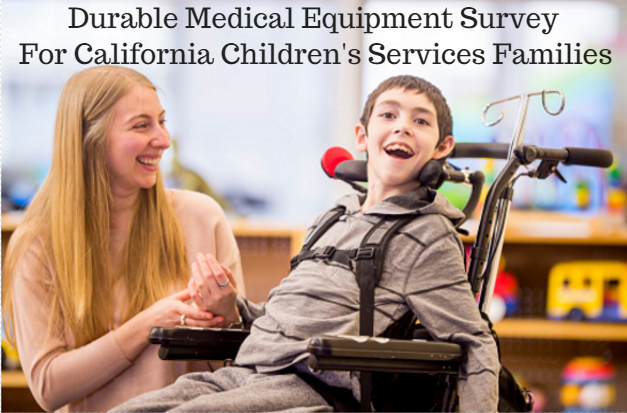
Have you ever had issues (length of wait, cost, etc.) accessing durable medical equipment (wheelchairs, walkers, lifts, etc.) for your child with special health care needs? The Department of Health Care Services (DHCS) has asked Family Voices of California to collect family input to help inform the California Children’s Services redesign team. We encourage you to take our survey and share your experience. To access the survey, click here.

All responses submitted by February 17 will be sent to the DHCS, but we welcome input past this date as it will be used in future advocacy efforts.

Calling All Youth With Disabilities 13-24 Years Old: Join Our Health Summit Youth Track!

We’re excited to be hosting our very first youth session at the Health Summit & Legislative Day in partnership with Youth Organizing! Disabled & Proud (YO!). Our youth track will address pediatric to adult care transition topics and will allow attendees to network with their peers and also learn from adults. To register, click here (flyer here). Date: Feb. 27

RESOURCES

Superintendent’s Report: Cutting Medicaid: A Prescription To Hurt The Neediest Kids

The School Superintendents Association (AASA) released a report last month after surveying states to assess the school-based impact potential Medicaid per-capita caps and block grants could have on children. They received close to 1,000 responses across 42 states from superintendents, school officials, special education directors, and agency leaders. The top two responses reflected deep concern over special educationspecifically, how districts would maintain the program in a block grant situation, and also how students in poverty would be impacted if Early And Periodic Screening, Diagnostic, And Treatment (ESPDT) services were no longer reimbursable. The AASA strongly urges Congress to reach out to school leaders for informed insight. To read the report, click here, and to read an article from the Washington Post discussing findings, click here.

Related: February 21 Medicaid And Public Schools webinar 

Related: Kaiser Family Foundation Brief: Medicaid And Children With Special Health Care Needs and 5 Key Questions: Medicaid Block Grants & Per Capita Caps

Report: Innovative Approaches In Care Coordination And Care Delivery For Children With Special Health Care Needs Among Safety Net Health Plans

The Association For Community Affiliated Health Plans examined 12 of its member plans nationwide (two in California: Health Plan of San Mateo and Inland Empire Health Plan) in an effort to highlight innovative models of care coordination for children with special health care needs. The report also provides a narrative about the range of plan efforts to improve outcomes, access to health care services, and other needed supports. To read the report, click here.

New Interactive Title V, Medicaid, And CHIP Worksheets From The Catalyst Center

The Catalyst Center has created new interactive worksheets for Title V program staff, family leaders, and other stakeholders. The worksheets provide an overview of Title V, Medicaid, and the Children’s Health Insurance Program (CHIP). Each worksheet includes resources you can use to find and insert state-specific information to help demonstrate the importance of Title V, Medicaid and CHIP for children with special health care needs. They were created as companion materials to the Catalyst Center’s Public Insurance Programs and Children with Special Health Care Needs: A Tutorial on the Basics of Medicaid and the CHIP. To view the worksheets, click here.

OPPORTUNITY FOR INPUT

Share Your Health Care Transition Challenges With The Hydrocephalus Association 

The Hydrocephalus Association will host a two-day workshop this month that will examine ways to improve the transition from pediatric to adult care for patients with hydrochephalus. The workshop will lead to a white paper that will propose a national plan of action and a set of measurable goals that can be reached within 5 to 10 years. To help further inform their research, the Hydrocephalus Association is encouraging those who have faced challenges transitioning (finding support in college, health insurance issues, locating a new neurologist, etc), to share their stories by emailing Jennifer at jennifer@hydroassoc.org. For more information, click here

Survey Of Caregivers For People With Disabilities: Family, Individual Needs For Support

The Arc is conducting a survey of caregivers for people with disabilities regarding their needs and the needs of their family members. The goal is to learn more about the experience of these caregivers. This survey was last conducted in 2010, and responses were compiled into a report which can be found here. To take the survey, click here.

Research Organization WestEd Seeks Feedback On Educational, Assistive Technology

The educational research organization WestEd is looking for parents of students with special needs (K-3rd grade) to participate in a research initiative. They’re looking to learn more about the use of educational and assistive technology and help further its development in partnership with Twin Cities PBS. Participation consists of a one-hour phone interview and parents will be given a $50 VISA gift card for their time. If you’re interested, email Laura at lgluck@wested.org or call her at (650) 381-6442 (please identify your child’s age and grade level in your message).

WEBINARS

February 16: Patient Advisory Councils From Scratch: Putting Together Nuts And Bolts

Sponsor: The Center For Care Innovations

More information and registration here.

February 17: Life Disabilities Found In Individuals With Prenatal Alcohol Exposure

Sponsor: Statewide Parent Advocacy Network

More information and registration here.

February 21: CDC Public Health Grand Rounds: Overcoming Barriers To Medication Adherence For Chronic Diseases

Sponsor: Centers For Disease Control And Prevention

More information and registration here.

February 21: Medicaid And Public Schools

Sponsor: Learning First Alliance

More information and registration here.

February 21: The Evaluation Process

Sponsor: Family Network On Disabilities

More information and registration here

February 22: Race, Equity, And Ethics: Questions On Child Welfare And Predictive Analytics

Sponsor: Alliance For Racial Equity In Child Welfare

More information and registration here.

February 22: Creating Systems For Individuals With Co-Occurring Mental Illness And Intellectual Disabilities

Sponsor: Substance Abuse And Mental Health Services Administration (SAMHSA)

More information and registration here.

February 23: Housing For People With Intellectual And Developmental Disabilities

Sponsor: UCS University Center For Excellence In Developmental Disabilities (UCEDD)

More information and registration here.

ARTICLES

Complex Child February Edition: Annual Feeding Tube & GI Issue

Children’s National Announces The Creation Of First-Of-Its-Kind Rare Disease Institute

I Don’t Speak For Laura

With Talk Of Medicaid Changes, Waiver Services May Be At Risk

Raising Awareness Of Congenital Heart Defects

Medicaid Changes Should Include Care For Special Needs Children

Trump Education Nominee Confirmed In Spite Of IDEA Concerns

Aging Out Of Pediatric Care: A Cautionary Tale

Depression Strikes Today’s Teen Girls Especially Hard

Fresno Unified Oks Six Student Health Centers – But Staffing A Concern

This Foster Father Takes In Only Terminally Ill Children

Like Us!
Videos!
Follow Us!
Email Us!